Parts is parts

I’m moving forward with the collection of parts for the drivetrain. The bits between the engine and wheel are missing. Drive shaft, brakes, U-joint and other things need to be sourced. I’ve been checking both Craig’s List and Ebay but only Ebay has anything consistently. I’m hoping to find another non-running Honda to use for parts, but they seem to be quite scarce here. I’ve ordered the sections of the drive shaft (there are three parts), drive gear hub, shifter rod, brake plate, swing arm, tachometer and others. The mail man will be bringing a lot of this car, bit by bit.

Finding the bits will be almost as much fun as the actual construction. I’ll have to make, or have made, changes to some of the parts. The drive shaft will have to extended considerably and hopefully a reverse gear mechanism added. The rear brake will need to have an auxiliary slave cylinder added to it can participate in the hydraulic braking action of the car instead of relying on the two front wheels.

These and countless other things will have to be planned and created. I’m hoping it will take less than a year. We’ll see.

Success, in theory anyway…

The Line Begins Here

I traveled down to the DMV to see in person just what I needed to do about getting this project legal after it is finished. There were over 50 people in line waiting for the door to open when I arrived at 7:45. Ouch, apparently the last day of the month is not the best time to choose to visit the DMV. Still, I had told the folks at work I might be late, and I wanted to see how far I’d get in the hour I had before work.

Predictably, I used most of that hour queueing, and then didn’t want to bail on that time invested, so I persisted and got to speak with Dorothy who had more than the usual clerk’s understanding of the fine details of vehicle registration. But my out-of-the-box project had her scratching her head. We took a little walk and visited Jamie in the inspections department and had a talk about what the car would be like and what would be required to get it licensed.

The guys in the inspection department seemed a bit confounded about why I wanted to build a car with three wheels, but were open to the idea. James said that in reviewing this project they would look to Honolulu for guidance since they have more experience with Special Interest Vehicles. Jamie said he would call the head of the DOT, John and get his input on how the Morgan replica would be classified and what would be needed to get it legal. I thanked him and took my leave.

So, that’s as much progress as I had hoped to get in this visit to the DMV. Now to wait for the call from Jamie to tell me what the DOT had ruled on my particular build.

Father’s Day Post

On Father’s Day two years ago, I started my first blog about plans for making a different sort of car. One inspired by the Lotus 7A my father owned. I was not able to complete that project, having to move to smaller quarters that didn’t have the space for such a project.

I’ve got a larger place now, and though space is tight, there’s room for a somewhat smaller build on the back Lanai, back porch to you not living in the 50th state.

So, a smaller project…. Yes, that’s one way to describe the Morgan three wheeler inspired vehicle I’m building. My father owned a red 1935 Morgan Super Sports with a two cylinder Matchless engine at the same time as the white Lotus 7. Now I never drove that car, but the smaller engine, unique looks and sporty handling should serve me well for a daily use car. It won’t have a top, and while I might get a bit of rain from time to time, it’s so dry and warm here in the lee of the volcano that it’s not a big deal when it happens. It will be even lighter than the Lotus, and should have a similar power to weight ratio.

The hosting for the old blog is about to be pulled, but since the first post of that blog still rings pretty true to me, I’m going to post it here as well.


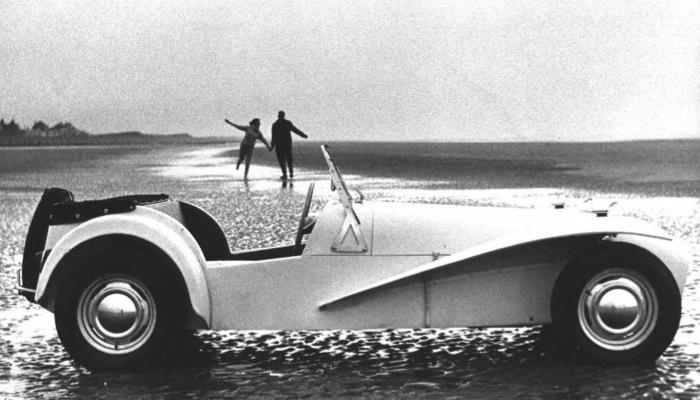
A Lotus 7A on the beach, from a period sales brochure.

Father’s Day

Sunday, June 20, 2010

I guess it’s appropriate I start this blog on Father’s Day, since this is all about building a car that is much like the one my father drove years ago. I always thought the Lotus was a very cool car. Small, sexy and cornered like it was on rails. And those swooping front fenders. They seemed extravagant on such a minimalistic car. Indeed, most builders are putting the smaller B, for British, or bicycle, fenders on their build. I haven’t decided yet about that detail, there’s so much more to do first.

I was actually only allowed to drive the car once, to get it serviced. The other time I “borrowed” it for a short drive, not realizing that it’s lack of a gas gauge would strand my father on the way home from work. It didn’t take him long to put two and two together and realize that it had been borrowed, and that’s why the he ran out unexpectedly. Thanks Dad, for not making a big deal of that.

When my Mom sold the Lotus after Dad passed away, Both of his sons showed up when the new buyer was due to arrive. “So you’ve come to help load the car?” my Mom asked.

“No” we both replied. We were there simply to witness it’s leaving, to say a little goodbye to this diminutive part of our family.

It was driving distilled to it’s essence. The leather wrapped steering wheel had no other tasks. No wiper stalk, no turn signals, no air bag, not even a horn button. The tubular steel frame, clad in aluminum and fiberglas body panels was strong and light.

One day I asked three friends to stand at each wheel. We knelt and picked up the car and held it at chest level. That’s a light-weight vehicle.

The 998cc Austin engine had enough umph to make the little guy get up and go. Zero to 60 times? Don’t know. Don’t care. Who would care when the next intersection beckoned you to turn right? It wasn’t about getting there fast, it was about enjoying the trip.

That pretty much sums up my father. He enjoyed the trip that was his life. Flying planes, hunting and fishing, cars and music were just some of the things he enjoyed.

He left this earth much sooner than most, but I feel he did a full life-time of living while he was here.

So here I go, on my own trip, working to make my own joy ride out of life. Wheeee.


DMV try Deux

I gave the DMV a call to see if I could ferret more details on the process of getting a constructed car a new VIN and license. I was quickly transferred to James in inspections, but not the type of inspections I was asking about. James’ department was the Safety Inspection department, apparently not the more through kind of inspection I need to get my car a new VIN.

I’ll have to go early before work to speak in person to the staff at the Kahului office and see it that makes it easier to get to the right department.

The Law

Here is the relevant listing in the Hawaii state laws concerning vehicles such as the one I am wanting to build. Its unclear how the state views three wheeled vehicles such as I’m building with motorcycle beginnings. It’s a good start for what I need to know, but there are many details that need to be filled in. That will come in time.

All this came from here.

§286-26.5 Special interest vehicles. (a) As used in this section:

     "Collector" means an owner of one or more vehicles,
including parts vehicles, who collects, purchases, acquires,
trades, or disposes of a vehicle or its parts, for the
owner's own use, to preserve, restore, and maintain the
vehicle or another vehicle for hobby or historical purposes.
     "Parts vehicle" means a vehicle that is owned by a
collector to furnish parts for the restoration or maintenance
of a special interest vehicle.
     "Street rod replica vehicle" means a vehicle that was
assembled from a manufactured kit, either as:

(1) A complete kit to construct a new vehicle consisting of a prefabricated body and chassis;

(2)  Components manufactured before 1968; or

(3)  Components manufactured after 1967 to resemble a vehicle manufactured before 1968;

and that has been modified in its body style or design
through the use of nonoriginal or reproduction components,
such as the frame, engine, drive train, suspension, or
brakes, in a manner that does not adversely affect its safe
performance as a motor vehicle or render the vehicle unlawful
for use on public highways.
     "Street rod vehicle" means a vehicle that was:

(1) Manufactured before 1968; or

(2) Manufactured after 1967 to resemble a vehicle manufactured before 1968;

and that has been modified in its body style or design
through the use of nonoriginal or reproduction components,
such as the frame, engine, drive train, suspension, or
brakes, in a manner that does not adversely affect its safe
performance as a motor vehicle or render the vehicle unlawful
for use on public highways.  The term does not include a
motorcycle, an antique vehicle, or a restored vehicle.
    (b)  If a street rod vehicle was manufactured before
1968 and has been modified in body style or design, the make
and year of the vehicle shall be the year the vehicle most
nearly resembles.  If a street rod vehicle was manufactured
after 1967 to resemble a vehicle manufactured before 1968,
the body type of the vehicle shall be street rod vehicle or
"STRD".
     (c)  A state vehicle identification number shall be
issued to a street rod vehicle that was manufactured after
1967 to resemble a vehicle manufactured before 1968, when no
vehicle identification number is present on the vehicle; when
more than one vehicle identification number is present on the
vehicle; or when the vehicle identification number is absent
from the body or frame, or both, of the vehicle.  The state
vehicle identification number shall be assigned by the
director of finance of the county in which the vehicle
resides; provided that not more than one hundred vehicle
identification numbers shall be issued annually.
     To obtain a state vehicle identification number under
this subsection, the owner of a street rod vehicle that was
manufactured after 1967 to resemble a vehicle manufactured
before 1968 shall provide:

(1) A title of ownership from the previous owner of the vehicle’s body or frame;

(2) A bill of sale or invoices for all major parts used in the modification of the vehicle; and

(3) A weight certificate issued by a state-certified scale for the actual weight of the vehicle.
(d) Notwithstanding any other law to the contrary:

(1) Street rod vehicles and street rod replica vehicles shall be equipped with the following equipment:

         (A)  Hydraulic service brakes on all wheels;
         (B)  Sealed beam or halogen headlights;
         (C)  Turn signals and a turn signaling switch;
         (D)  Safety glass or lexan windshield;
         (E)  Electric or vacuum windshield wiper located in
               front of the driver;
         (F)  Standard or DOT/SAE-approved tail lights;
         (G)  A parking brake that operates on at least two
               wheels on the same axle; and
         (H)  Seat belt assembly as provided in section 291-11.6;

(2) Street rod vehicles and street rod replica vehicles shall be equipped in such a manner that no part of a vehicle, other than the vehicle’s tires, will make contact with the surface of a flat highway when the vehicle is operated on the same;

(3) Bumpers, hoods, door handles, and fenders shall be optional equipment on street rod vehicles and street rod replica vehicles; and

(4) Bumpers, hoods, door handles, and fenders shall be optional equipment on vehicles manufactured before 1968, and on vehicles manufactured after 1967 to resemble a vehicle manufactured before 1968.

     In the event of a conflict between this subsection and
equipment requirements specified in chapters 286, 291 and
291C, this subsection shall control.
     (e)  If a street rod replica vehicle was assembled from
a manufactured kit as a complete kit to construct a new
vehicle consisting of a prefabricated body and chassis, the
year of the vehicle shall be the year the vehicle resembles
as reflected on the manufacturer's certificate of origin.  If
a street rod replica vehicle was assembled from a
manufactured kit as components manufactured before 1968 or
components manufactured after 1967 to resemble a vehicle
manufactured before 1968, the year of the vehicle shall be
the year the vehicle resembles as reflected on the
manufacturer's certificate of origin.  The certificate of
title for a street rod replica vehicle shall be for the make
and year the vehicle resembles, and the body type of the
vehicle shall be street rod vehicle replica (STRD-RPLC).
     (f)  The state vehicle identification number of a
street rod replica vehicle that was assembled from a manufactured
kit as a complete kit to construct a new vehicle consisting of
a prefabricated body and chassis shall be taken from the
manufacturer's certificate of origin.  The state vehicle
identification number shall be assigned by the director of
finance of the county in which the vehicle resides; provided
that not more than one hundred vehicle identification numbers
shall be issued annually.
     The state vehicle identification number of a street rod
replica vehicle that was assembled from a manufactured kit as
components manufactured before 1968 or components
manufactured after 1967 to resemble a vehicle manufactured
before 1968, shall be taken from the manufacturer's
certificate of origin or provided by the director of finance
of the county in which the vehicle resides.
     To obtain a state vehicle identification number under
this subsection, the owner of a street rod replica vehicle
shall provide:

(1) Ownership documents from the manufacturer of the kit or components;

(2) All shipping and freight documents for the kit or components; and

(3) A weight certificate issued by a state-certified scale for the actual weight of the vehicle.

     (g)  A state vehicle identification number shall be
issued to a street rod replica vehicle when the vehicle
identification number is absent from the body or frame, or
both, of the vehicle; or when the vehicle identification
number is absent from the manufacturer's certificate of
origin.  The state vehicle identification number shall be
assigned by the director of finance of the county in which
the vehicle resides; provided that not more than one hundred
vehicle identification numbers shall be issued annually. [L
1997, c 246, §2; am L 2004, c 126, §2]